

Safe Lifting & Manual Handling
Assess the load. Reduce the strain. Ask for help.
Construction workers regularly lift, carry, push and pull bricks, cement bags, tools and building materials. Repeated handling, heavy loads and awkward movements can lead to back injuries, muscle strain and other physical problems.
Safe manual handling is not simply about lifting with the correct posture. It begins by deciding whether the load should be moved manually at all.
Understand the Risk
Manual handling includes lifting, lowering, carrying, pushing and pulling objects using bodily force.
The level of risk depends on several factors:
- The load: its weight, size, shape, stability and grip.
- The task: how often it is repeated, how far it must be carried and whether twisting or reaching is required.
- The environment: uneven surfaces, restricted spaces, heat and obstacles.
- The worker: physical capability, fatigue and experience.
A light object can still cause problems if it is handled repeatedly in an awkward position. A bulky object can be dangerous even when it is not particularly heavy.

Find a Safer Way to Move the Load
Before lifting, consider whether the task can be made easier or safer.
- Use a trolley, hand truck, hoist or other suitable mechanical aid where available.
- Divide a load into smaller units when practical.
- Reduce the carrying distance where possible.
- Clear the route before moving the material.
- Ask for assistance when the load is too heavy, bulky or difficult to control.
Do not assume that a load is safe simply because another worker can lift it.
Lift and Lower With Control
When manual lifting is appropriate, plan the movement before starting.
- Check the load’s weight, stability and available grip.
- Stand close to the load with stable footing.
- Use a comfortable, balanced position and bend your hips and knees as appropriate.
- Keep the load close to your body where possible.
- Lift smoothly without jerking or sudden movements.
- Turn by moving your feet rather than twisting your back under load.
- Lower the load under control and keep fingers clear of pinch points.
Do not attempt to lift a load that exceeds your capability. Good technique reduces some risks but cannot make an excessively heavy or awkward load safe.
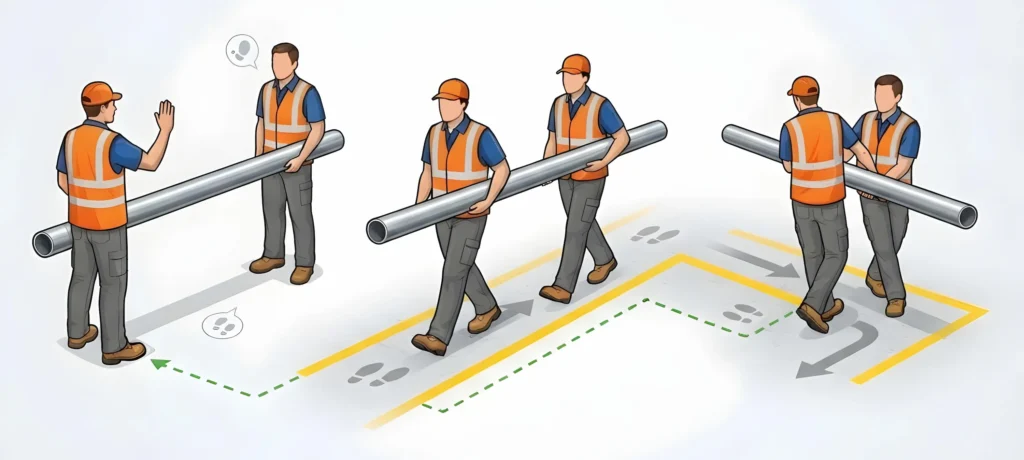
Carrying, Team Lifting and Difficult Loads
A load that is manageable at the start may become difficult to control over a long distance or across an uneven surface.
- Check that the route is clear, stable and suitable for the load.
- Make sure you can see where you are going.
- Avoid carrying objects that block your view or prevent a secure grip.
- For team lifting, agree on the route and who will lead the movement.
- Coordinate when lifting, walking, turning and lowering.
- Stop if the load becomes unstable or communication breaks down.
For long, bulky or unusually shaped materials, use an appropriate handling method rather than relying on strength alone.
Recognize Strain and Report Problems
Pain, unusual discomfort, fatigue or difficulty controlling a load are warning signs that the task may need to change.
Stop and reassess rather than pushing through discomfort. Report recurring handling problems so the supervisor can consider better equipment, task redesign, adjusted workloads or additional training.
Early reporting can help prevent a small problem from becoming a more serious injury.
Quick Manual Handling Check
☐ Are walkways and access routes clear?
☐ Are materials stacked securely?
☐ Are pipes, rods and other round materials prevented from rolling?
☐ Have waste and sharp objects been contained?
☐ Are emergency equipment and exits accessible?
☐ Is anything stored where it could fall or collapse?
A load that seems manageable can still cause injury when lifted or carried incorrectly.
Assess the load, choose a safer way to move it and never hesitate to ask for help.
LIFT SMART. REDUCE THE STRAIN.
CONSTRUCTION WORKERS SAFETY
Learn | Prevent | Protect